Teaching Chinese in preschool and primary school: a simple lesson plan
An introduction to Mandarin fits neatly into six lessons of 30 to 45 minutes. This plan is for teachers, club leaders and visiting tutors, including those who do not speak Chinese: each lesson gives the goal, the words, the steps and the printable materials.
Before you start
Goals of the unit
- Discover a tonal language and hear its music.
- Understand and say about fifteen useful words and phrases.
- Count from 1 to 10, out loud and with Chinese hand gestures.
- Recognise a few simple characters and know that they started as pictures.
- Learn about a festival: Chinese New Year, on 6 February 2027.
If you don’t speak Chinese
Pronunciation comes from native recordings: nursery rhyme videos, online dictionaries with audio, apps with sound. Listen to every word before the lesson, play the recording in class, then repeat it with the pupils. A Chinese-speaking parent or a visiting tutor can lead one lesson: agree on the word list beforehand so the lesson stays on track.
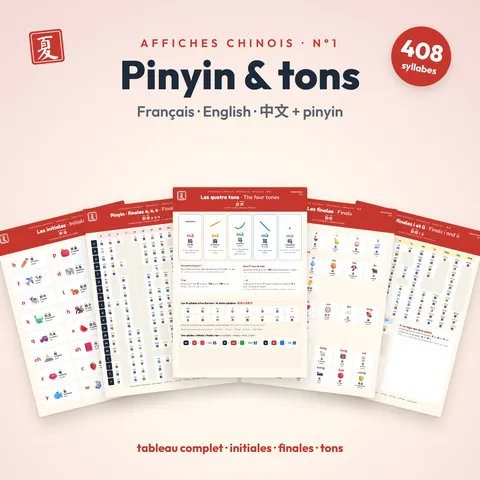
Pinyin, the Latin alphabet that spells out pronunciation, is your guide for reading the words. The guide to pinyin and tones shows how to read it in ten minutes.
The routine for every lesson
Always open the same way: pupils say lǎoshī hǎo 老师好 “hello teacher”, you reply tóngxuémen hǎo 同学们好 “hello class”. Close with xièxie 谢谢 and zàijiàn 再见. The routine takes one minute and makes the language feel familiar.
The six lessons at a glance
| Lesson | Goal | Key words | Activity |
|---|---|---|---|
| 1 | Greetings | 你好 nǐ hǎo, 再见 zàijiàn, 谢谢 xièxie | Hello circle, puppet |
| 2 | Saying your name | 我叫… wǒ jiào, 你叫什么名字? | Ball game |
| 3 | Counting 1 to 10 | 一 yī to 十 shí | Hand gestures, counting song |
| 4 | Colours | 红 hóng, 黄 huáng, 蓝 lán, 绿 lǜ | “Touch the colour” game |
| 5 | Animals and characters | 猫 māo, 狗 gǒu, 鱼 yú; 人 山 水 日 月 | Memory game, guess the picture |
| 6 | Review and New Year | 新年快乐 xīnnián kuàilè | Red and gold craft, short show |
In preschool and kindergarten, split each lesson into two slots of 15 to 20 minutes in the same week. In primary school, one 45-minute lesson a week for six weeks fits into a half term.
Lessons 1 to 3: greetings, names, numbers
Lesson 1: greetings
Play nǐ hǎo 你好 “hello” several times, then say it while shaking each pupil’s hand. Add zàijiàn 再见 “goodbye” and xièxie 谢谢 “thank you”. A puppet “who only speaks Chinese” helps the youngest: it says hello, thanks the class and leaves. To finish, each pupil says goodbye to the puppet.
Lesson 2: saying your name
The question nǐ jiào shénme míngzi 你叫什么名字? “what is your name?” is answered with wǒ jiào 我叫 + name. Sitting in a circle, pupils pass a ball: whoever catches it says “wǒ jiào Sam” and throws the ball while asking the question. Older pupils can add wǒ liù suì 我六岁 “I am six”.
Lesson 3: counting from 1 to 10
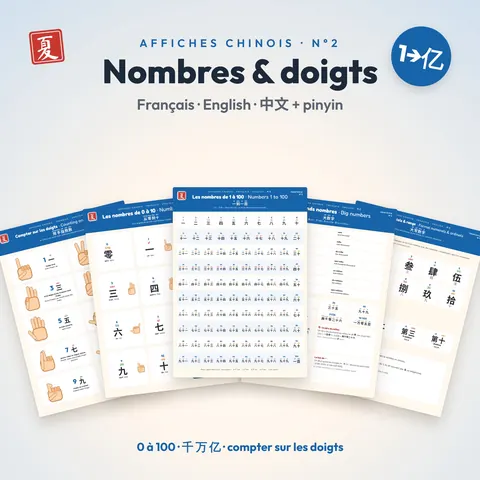
The numbers are 一 yī, 二 èr, 三 sān, 四 sì, 五 wǔ, 六 liù, 七 qī, 八 bā, 九 jiǔ, 十 shí. In China people count from 1 to 10 on one hand, with a gesture for each number: children love them and they help memory. The guide counting in Chinese on your fingers describes each one. Game: you show a gesture and the class says the number, then swap.
Lessons 4 to 6: colours, animals, characters, festival
Lesson 4: colours
Four colours are enough: 红 hóng red, 黄 huáng yellow, 蓝 lán blue, 绿 lǜ green. Put coloured sheets in the four corners of the room; you call a colour and the pupils run to touch it. Seated version: each pupil holds up a pencil of the colour called. Explain that red is the colour of celebration and good luck in China.
Lesson 5: animals and first characters
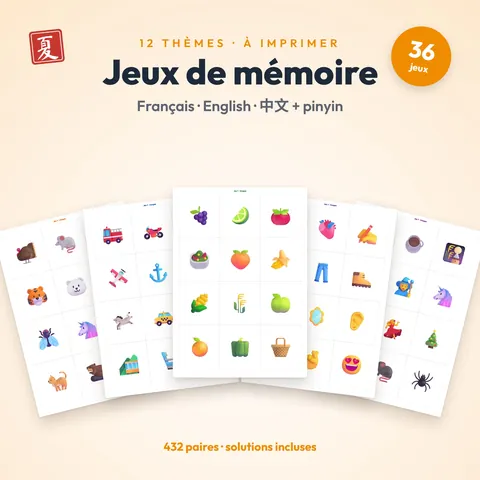
Six animals: 猫 māo cat, 狗 gǒu dog, 鱼 yú fish, 鸟 niǎo bird, 马 mǎ horse, 羊 yáng goat or sheep. A memory game with pictures on one side and words on the other keeps groups of four busy.
Then show six characters that began as drawings: 人 rén person (two legs), 口 kǒu mouth, 山 shān mountain (three peaks), 水 shuǐ water, 日 rì sun, 月 yuè moon. Draw the object first, then the character beside it: pupils guess which goes with which. Primary pupils then trace two characters on a 田字格 tiánzìgé grid, following stroke order.
Lesson 6: review and Chinese New Year
The review lesson goes over everything through games: greetings, names, numbers, colours, animals. If it falls in January or early February, make it a New Year lesson: xīnnián kuàilè 新年快乐 “Happy New Year”, a 福 fú “good fortune” character to colour in red and gold, and the animal of 2027, the goat 羊 yáng. The guide to Chinese New Year activities has ready-made workshops.
Materials to prepare
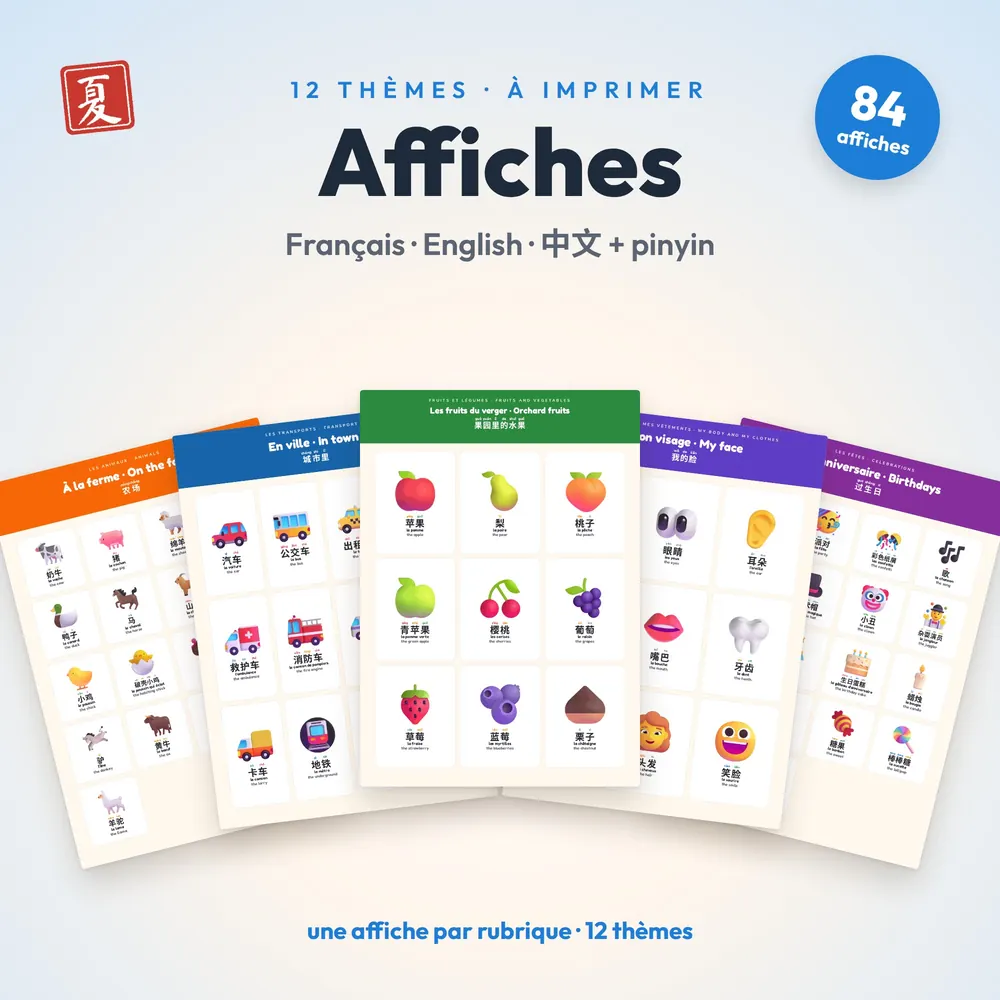
The whole unit needs very little: a way to play audio, a few posters on the wall, a set of picture cards and, for older pupils, handwriting sheets.
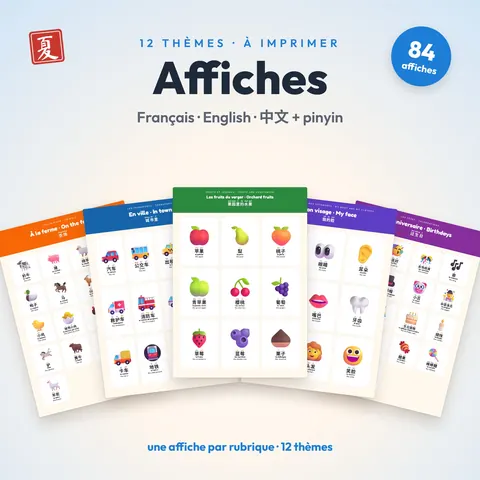
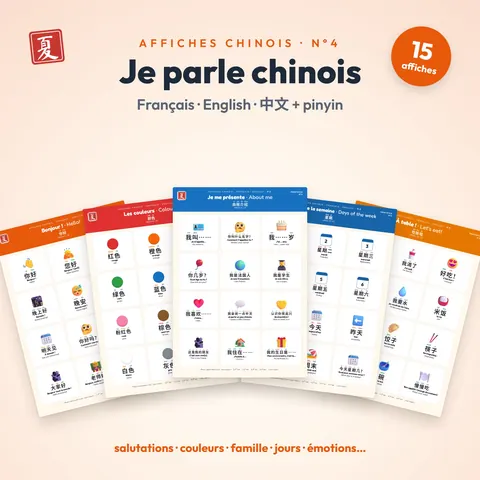
- Posters: word and sentence posters on the wall act as the class memory. The “I speak Chinese” posters gather 184 words and sentences with pinyin, in French and English, on 15 sheets.
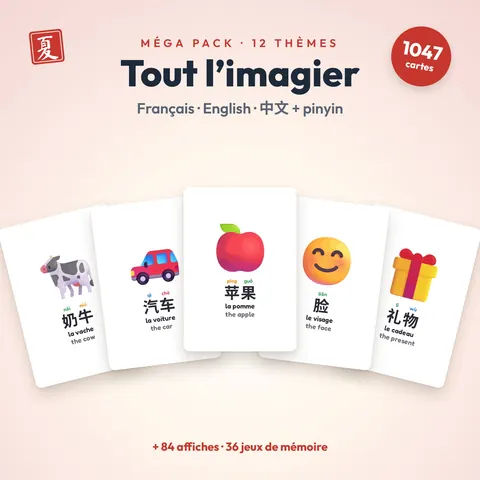
- Picture cards: for naming, sorting and bingo. The trilingual picture dictionaries come by theme (animals, colours and numbers, school…).
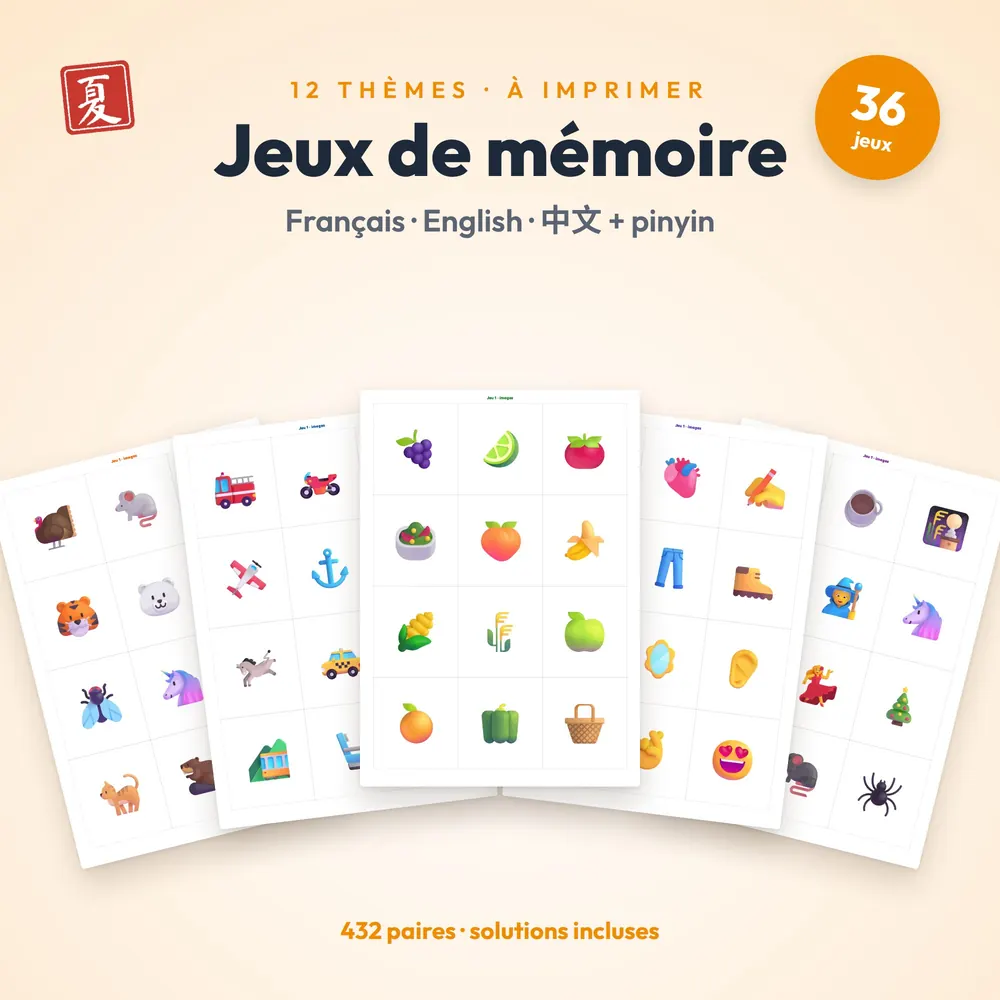
- Memory games: for lessons 4 and 5, in groups.
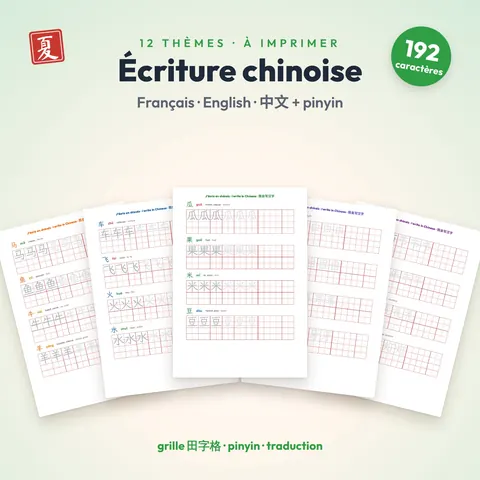
- Handwriting sheets: 田字格 grids for tracing, printable in black and white.
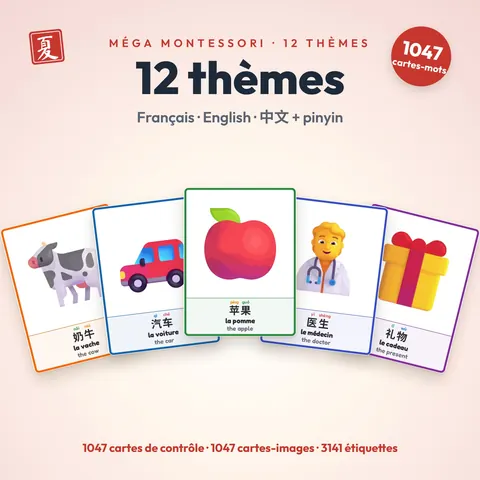
- Montessori cards: in preschool, to match picture and word independently (three-part cards).
Adapting to the age group
Preschool and kindergarten (ages 3 to 6)
Speaking and listening come first. Short lessons, plenty of repetition, movement and songs. No writing is expected; characters can be shown like pictures. Five-year-olds enjoy hunting for a “hidden” character on a poster. Keep the same words from one lesson to the next rather than adding new ones.
Primary school (ages 6 to 11)
Add pinyin as a reading aid and a few characters to trace. Older pupils can compare languages: no verb conjugation in Chinese, no plural -s, one character per syllable. A small Chinese notebook, one page per lesson, keeps track of the words learnt.
Light-touch assessment
A light assessment is enough: watch during games rather than giving a test. Three simple markers for each pupil:
- Answers the greeting routine without help.
- Counts from 1 to 10 out loud, with or without gestures.
- Recognises at least three words or characters seen in class.
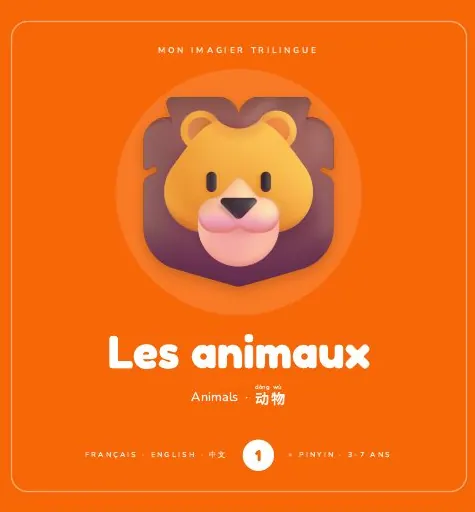
To carry on, one lesson a week on a new theme (food, home, transport) extends the unit. The “Mon imagier trilingue” books can stay in the reading corner.
Frequently asked questions
Can I teach Chinese without speaking it?
Yes, for an introduction. Pronunciation comes from native recordings, pinyin helps you read the words, and the teacher learns alongside the pupils.
What age can children start Chinese at school?
From age 3 with listening, songs and pictures. Tracing characters fits better from age 6.
How long should a lesson be?
15 to 20 minutes in preschool, 30 to 45 minutes in primary school. Regularity matters more than length.
Do pupils need to learn to write characters?
Not for an introduction. Recognising a few simple characters such as 人 rén, 山 shān or 日 rì is enough; tracing on a grid can be offered to primary pupils.
When should the Chinese New Year lesson take place?
In 2027 Chinese New Year falls on Saturday 6 February, so the week of 1 to 5 February works well for a lesson or a theme week.