Counting in Chinese with your fingers
In China, people count from 1 to 10 on one hand. The gestures for 6 to 10 surprise children used to counting on two hands, which is exactly what makes them fun to learn. This guide covers the gestures, the pronunciation, how to build numbers up to 99 and games to make them stick.
Numbers 0 to 10 and their gestures
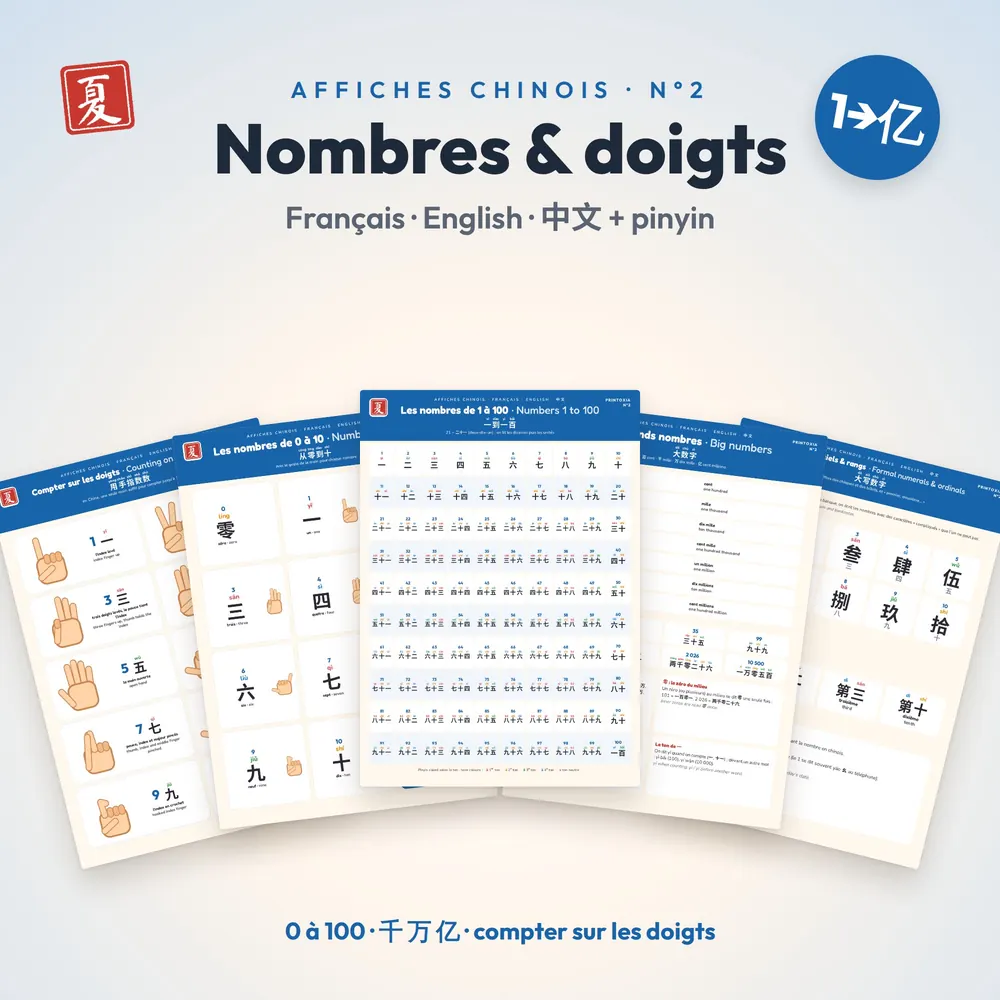
Chinese numbers from 1 to 10 are short: one syllable each. The gesture goes with the word and helps the child remember it, linking sound, hand and sometimes the shape of the character.
| Number | Character | Pinyin | One-hand gesture | Memory hook |
|---|---|---|---|---|
| 0 | 零 | líng | Closed fist, or a circle made with the fingers | Nothing in the hand |
| 1 | 一 | yī | Index finger up | One stroke, one finger |
| 2 | 二 | èr | Index and middle fingers up | Two strokes, two fingers |
| 3 | 三 | sān | Index, middle and ring fingers up | Three strokes, three fingers |
| 4 | 四 | sì | Four fingers up, thumb folded | The character is a box with two “legs” inside |
| 5 | 五 | wǔ | Open hand | The whole hand |
| 6 | 六 | liù | Thumb and little finger out, other three folded | The “phone” sign |
| 7 | 七 | qī | Tips of thumb, index and middle finger pinched together | Pinch 七 like a bird’s beak |
| 8 | 八 | bā | Thumb and index finger out in an L | The two spread fingers draw 八 |
| 9 | 九 | jiǔ | Index finger bent into a hook | The hook looks like the end of 九 |
| 10 | 十 | shí | Closed fist, or two index fingers crossed | Crossed fingers draw 十 |
Say the number while making the gesture, then ask the child to make the gesture when you say the number, and the other way round. Start with 1 to 5, then add 6 to 10 the following week.
The tones of the numbers
The first ten numbers cover all four tones: yī, sān, qī, bā in the 1st tone (red on our materials); líng and shí in the 2nd tone (orange); wǔ and jiǔ in the 3rd tone (green); èr, sì and liù in the 4th tone (blue). Counting out loud is good tone practice. The guide learning the 4 tones through play has more ideas.
Building numbers from 11 to 99
Once the first ten are known, the rest are built like a construction set, with no exceptions:
- 11 to 19: ten + unit. 十一 shíyī 11, 十五 shíwǔ 15, 十九 shíjiǔ 19.
- Tens: number + ten. 二十 èrshí 20, 三十 sānshí 30, 九十 jiǔshí 90.
- 21 to 99: number + ten + unit. 二十一 èrshíyī 21, 三十五 sānshíwǔ 35, 九十九 jiǔshíjiǔ 99.
- 100: 一百 yìbǎi.
Children often like this logic: no “eleven” or “twelve” to memorise separately. Eleven is simply “ten one”, 十一 shíyī, and seventy is “seven ten”, 七十 qīshí.
To show 35 with your hands, make 3 then 5, one after the other. Bigger numbers are said rather than shown.
Two traps: 两 and 零
二 èr or 两 liǎng?
When counting, reciting or reading out a number, say 二 èr: one, two, three is yī, èr, sān. But in front of a word that counts objects (a measure word), say 两 liǎng: 两个苹果 liǎng gè píngguǒ two apples, 两只猫 liǎng zhī māo two cats. In 12, 20 or 22, keep 二: 十二 shí’èr, 二十二 èrshí’èr.
零 líng, zero
Zero is spoken when there is a “gap” in a number: 105 is 一百零五 yìbǎi líng wǔ, “hundred zero five”. It is also used for phone numbers and years, read digit by digit: 2027 is èr líng èr qī.
A nursery rhyme and games
The tiger rhyme
Every child in China knows this counting rhyme:
- 一二三四五 yī èr sān sì wǔ, one, two, three, four, five,
- 上山打老虎 shàng shān dǎ lǎohǔ, up the mountain to hunt a tiger,
- 老虎没打到 lǎohǔ méi dǎ dào, didn’t catch the tiger,
- 打到小松鼠 dǎ dào xiǎo sōngshǔ, caught a little squirrel.
Count on the fingers of one hand during the first line, then act out the rest.
Five 5-minute games
- How many fingers? Two players show one hand at the same time and call out the total in Chinese. The fastest scores a point. From age 5, that is already addition.
- Teacher says: the Chinese version of “Simon says”, 老师说 lǎoshī shuō. “老师说: show 8!” The child makes the gesture only if the sentence starts with 老师说.
- The market: paper fruit and price tags from 1 to 10 kuài 块. The child buys, pays with counters and counts the change.
- The dice: roll a die and say the number in Chinese before moving your counter. With two dice, add them up.
- The stairs: count the steps on the way up, from yī to shí, then carry on with shíyī. Nothing to prepare.
From fingers to maths
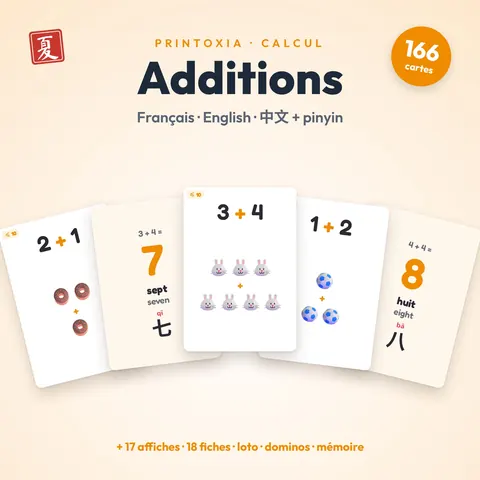
The gestures work well for first additions. The child shows 3 on one hand, 2 on the other, and counts the total: 三加二等于五 sān jiā èr děngyú wǔ, three plus two equals five. To subtract, they fold fingers down: 五减一等于四 wǔ jiǎn yī děngyú sì, five minus one equals four.
A handful of words is enough for maths in Chinese: 加 jiā plus, 减 jiǎn minus, 等于 děngyú equals, 多少 duōshao how many. Around 7 or 8, add 乘 chéng times.
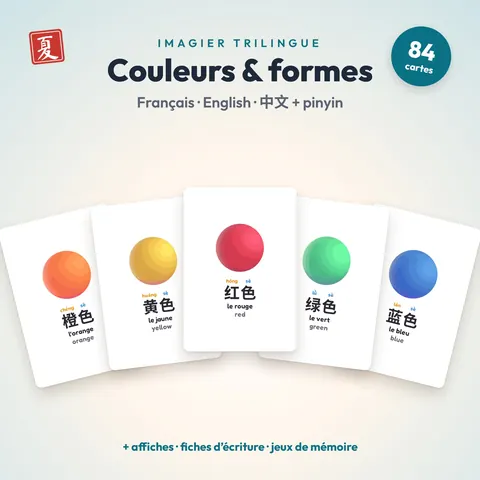
For practice on paper afterwards, the maths collection brings together cards, posters and worksheets with answers.
Writing the numbers
一, 二 and 三 are the first characters many children write: one, two, three horizontal strokes, drawn top to bottom and left to right. The bottom stroke of 二 and 三 is the longest.
十 takes two strokes: horizontal first, then vertical. 四 has five, 五 has four. A 田字格 grid helps place each stroke. The strokes and radicals poster shows the stroke order rules.
On receipts and cheques you may also see more complex “formal” numerals, such as 壹 for one or 贰 for two. They prevent tampering; children do not need them to start.
Good to know: lucky numbers and regional variations
4 and 8
In China, 四 sì sounds close to 死 sǐ, to die: some buildings skip the 4th floor. On the other hand, 八 bā recalls 发 fā, to prosper, and 8 is popular. The Beijing Olympics opened on 8 August 2008 at 8:08 pm. With children, tell it as a curiosity rather than a rule.
Gestures that vary
The gestures in this guide are those of mainland China. In Taiwan, Hong Kong, Guangdong, Singapore or Malaysia, 7, 8 and 10 can be made differently: the L shape may mean 7 there, and some people show 10 with both hands. If a classmate uses another gesture, neither of them is wrong.
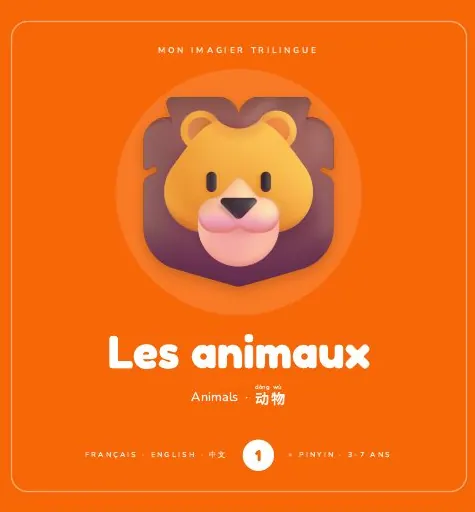
The Mon imagier trilingue books make a natural next step: count the animals on each page in Chinese.
Frequently asked questions
How do you count to 10 in Chinese?
yī, èr, sān, sì, wǔ, liù, qī, bā, jiǔ, shí. Each number has a character: 一 二 三 四 五 六 七 八 九 十.
How do you show 6, 7, 8, 9 and 10 on one hand?
6: thumb and little finger out. 7: tips of thumb, index and middle finger pinched. 8: thumb and index in an L. 9: index bent into a hook. 10: closed fist or crossed index fingers.
What is the difference between 二 and 两?
Use 二 èr for counting and inside numbers (十二, 二十). Use 两 liǎng before a word that counts objects: 两个 liǎng gè, two of something.
How do you say 100 in Chinese?
一百 yìbǎi. 99 is 九十九 jiǔshíjiǔ.
What age can children learn to count in Chinese?
From 3 for 1 to 5 with gestures and the rhyme, 1 to 10 around 4, up to 100 from about 6.