Montessori three part cards: a how-to guide
Three part nomenclature cards are a classic Montessori tool for building vocabulary. The idea fits in one sentence: the child matches a picture with a word, then checks the work alone with a control card. Here is how to prepare them, present them step by step and use them to learn words in Chinese, English or French.
What a set of cards contains
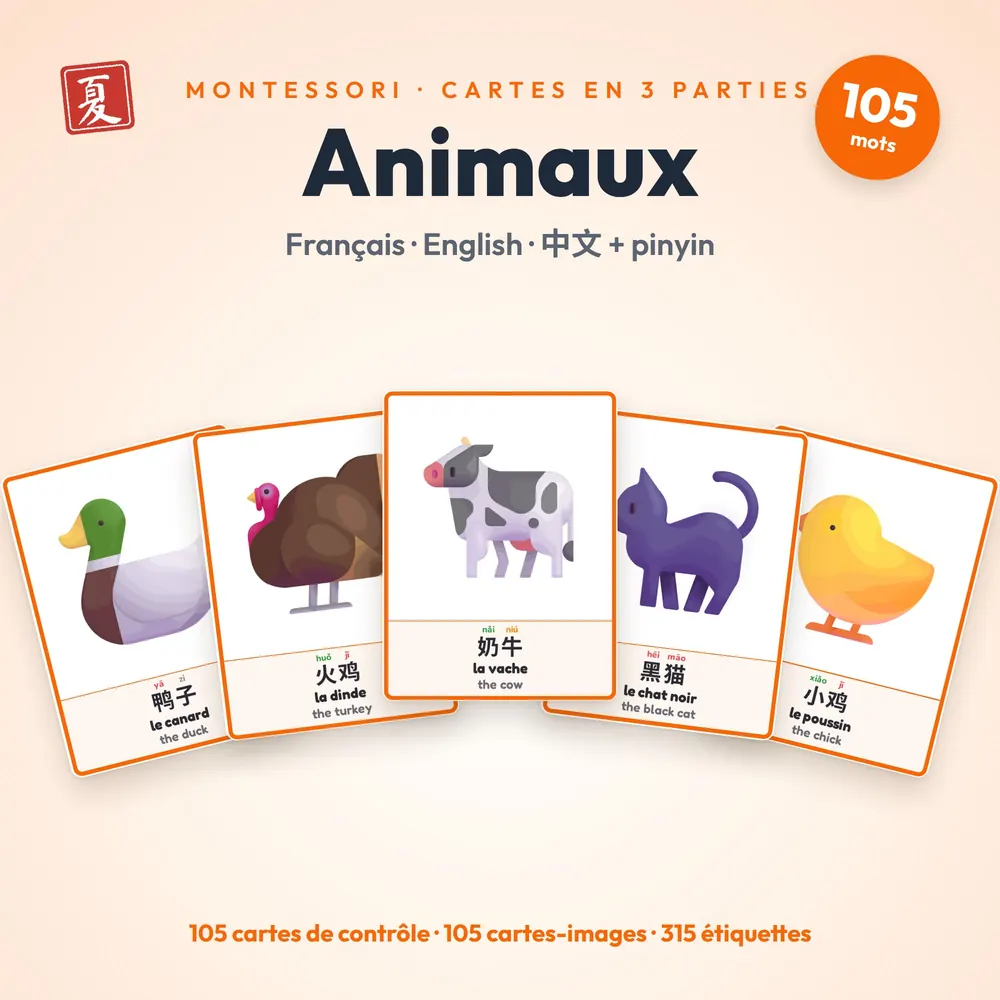
Each word comes as three cards:
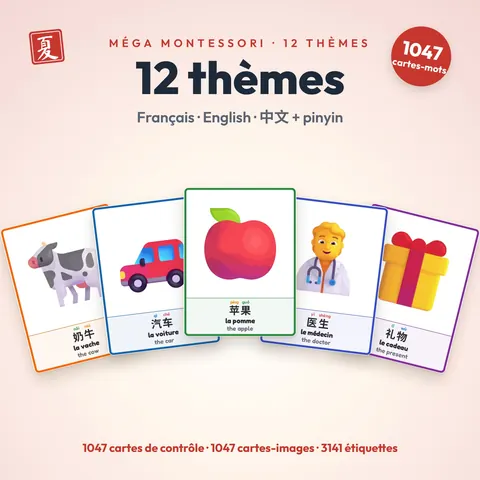
- The control card: the picture with the word printed underneath. It is the model and the answer key.
- The picture card: the same picture without the word.
- The label: the word alone, to place under the picture.
The child lays the picture cards in a row, places the matching label under each one, then compares with the control cards. That comparison is what makes the activity independent: the adult does not need to say “that’s wrong”, the child sees the difference.
For a foreign language, the label carries the word in the target language. In Chinese, the character is written with pinyin above it: 猫 māo cat. On trilingual cards the label shows French, English and Chinese together.
Preparing the cards
Printing
Print on heavy paper (160 to 200 gsm, about 60 to 75 lb cover) or matte photo paper so the cards stand up to handling. Pick A4 or US Letter to match your printer and print at actual size (100 %), without fit to page.
Cutting
A paper trimmer saves a lot of time. Cut the control cards first, then the picture cards, then the labels, and keep each word together on the table until all three cards are ready. A set of 12 words takes about 20 minutes.
Laminating or not
Laminating protects the cards from fingers and snacks, which helps in a classroom or with children under 4. At home, heavy paper is often enough; just reprint a damaged card.
Storing
One envelope or small box per theme: animals, fruit, transport. Inside each box, three piles held by a clip or a rubber band. A label on the box with the theme and the number of words stops cards getting lost. Children tidy up on their own if each box has its place on a low shelf.
Presenting the cards step by step
Before the child reads (ages 2 to 5)
Start with picture cards and control cards only, no labels. Choose 3 to 5 words the child already knows in their own language, such as cat, dog, rabbit.
- Lay out a mat or a tray. Sit next to the child, on their left if they are right-handed.
- Place the control cards in a column, naming each picture: “猫 māo”.
- Hand the child a picture card and ask them to place it next to the same picture.
- Repeat until every picture has its pair.
- Tidy up together. A session lasts 5 to 10 minutes.
Once the child reads (from about 5 or 6)
- Line up the picture cards along the top of the mat.
- The child reads each label and places it under the matching picture.
- Then they place each control card under its pair, or turn it over to compare.
- If they spot a difference, they swap the labels themselves.
In Chinese, a child who cannot read characters yet can lean on colour-coded pinyin: the colour shows the tone (red for 1st, orange for 2nd, green for 3rd, blue for 4th, grey for neutral). They first “read” the shape of the character like a drawing, then come to recognise it.
The three period lesson, applied to Chinese
The three period lesson is the Montessori way of introducing new words. It works with 3 words at a time, no more.
1. Naming: “This is…”
Show each card and say only the word, clearly, two or three times: “This is 猫 māo. This is 狗 gǒu. This is 兔子 tùzi.” No long sentence, no question.
2. Recognising: “Show me…”
This is the longest period. Ask: “Show me 狗 gǒu. Put 兔子 tùzi on your head. Give me 猫 māo.” Shuffle the cards between questions. The child hears each word many times without having to say it.
3. Recalling: “What is this?”
Only when the child gets the second period right without hesitating, show a card and ask: “这是什么? zhè shì shénme What is this?” They say the word. If they get it wrong, go back to the second period without commenting, or pick it up the next day.
The next day, add one new word, for example 苹果 píngguǒ apple, and keep two known words to build confidence.
Games and variations
- Bilingual or trilingual: place the picture card, then two or three labels in different languages underneath. The child sees that “chat”, “cat” and 猫 māo name the same animal.
- Hide and seek: hide 5 picture cards around the room. The child brings each one back and names it in Chinese.
- Sorting: mix farm and wild animals, or fruit and vegetables. The child makes two piles and explains the choice.
- Memory: lay the picture cards and control cards face down. Turn over two at a time and say the word for each pair found.
- With figurines: place a small cow or a toy car on the matching card. The real object helps younger children link it to the picture.
- Mystery bag: a figurine in a cloth bag; the child feels it, guesses, then finds the card.
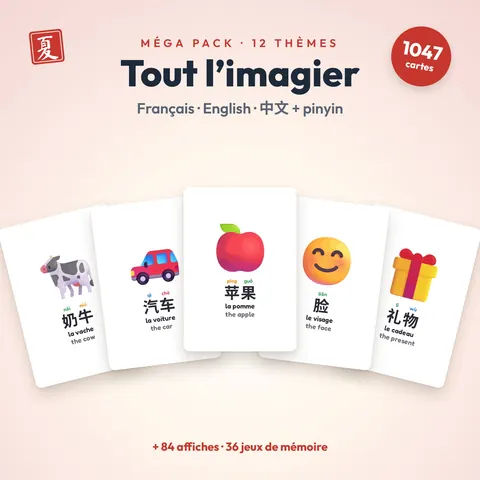
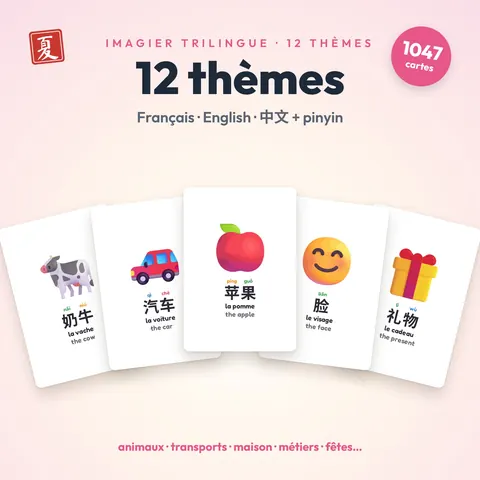
To keep working with the same vocabulary, the trilingual flashcards offer double-sided cards and memory games on the same 12 themes.
Progression by age
| Age | Activity | Number of words |
|---|---|---|
| 2 to 3 | Match picture to picture (control card and picture card), figurines, naming | 3 to 5 per session |
| 3 to 6 | Three period lesson, hide and seek, sorting, memory | 5 to 10 per theme, then the whole theme |
| 6 and up | Reading labels, pinyin, first characters, writing the word under the picture | Whole themes, reviewing older ones |
A 12-word theme often fills one or two weeks at a few minutes a day. Come back to older boxes regularly: a word not seen for a month fades quickly.
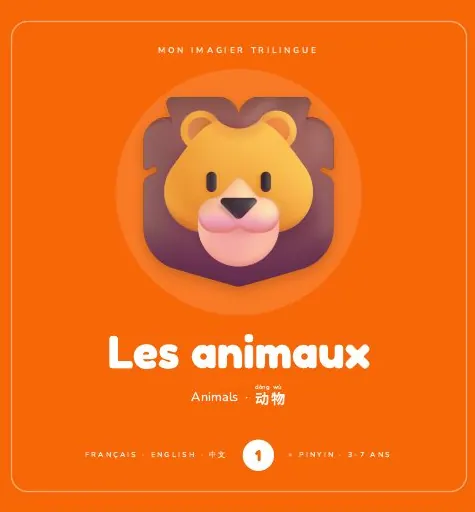
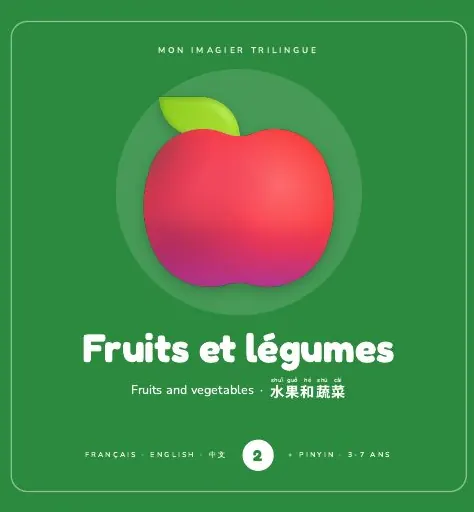
The Mon imagier trilingue books follow the same themes, so the child meets the words from the cards again in a book, for example in the fruit and vegetables volume.
Common mistakes and classroom use
What to avoid
- Too many cards at once: beyond 5 new words, children start guessing.
- Moving to the third period too early: asking for the word before the child recognises it sets them up to fail.
- Correcting out loud: let the control card do that job.
- Abstract words at the start: begin with things the child sees and touches every day.
- Approximate pronunciation: if you are new to Chinese, listen to a native recording before the session. The guide pinyin explained for parents helps with the tricky sounds.
In the classroom
In preschool and kindergarten, three part cards work well as independent stations: one box per table, four pupils, ten minutes. The teacher runs the three period lesson in a small group, then the box stays available. Print one set per station and an extra control card for the wall. The guide Chinese in preschool and primary school offers a full sequence built around these cards.
Frequently asked questions
What are Montessori nomenclature cards?
A set of three cards per word: the picture with the word (control card), the picture alone and the word alone. The child matches picture and word, then checks with the control card.
What age are three part cards for?
From age 2 for matching pictures and naming. Reading the labels comes around 5 or 6.
How many cards should I show at once?
Three new words for the three period lesson, five at most for a matching game. Add one word a day while keeping the known ones.
Can I use these cards to teach Chinese if I don’t speak it?
Yes. Colour-coded pinyin shows the tone, and a native recording models the pronunciation. The adult learns the words alongside the child.
Do the cards need laminating?
No. Paper of 160 to 200 gsm is enough at home; laminating helps in a classroom or with toddlers.