Teaching Chinese to a child when you don’t speak Chinese
Many parents and teachers want to introduce Chinese to a child without speaking it themselves. It works, as long as native voices model the pronunciation and the written materials are something the adult can read.
Start with listening
Children learn by listening first. Before reading or writing, they need to hear plenty of Chinese: nursery rhymes, cartoons, audiobooks, videos by native speakers. A few minutes a day is enough, in the background while playing or watching together.
The adult does not need a flawless accent: you set the example by repeating, and native recordings are the reference for tones.
Name things with pictures
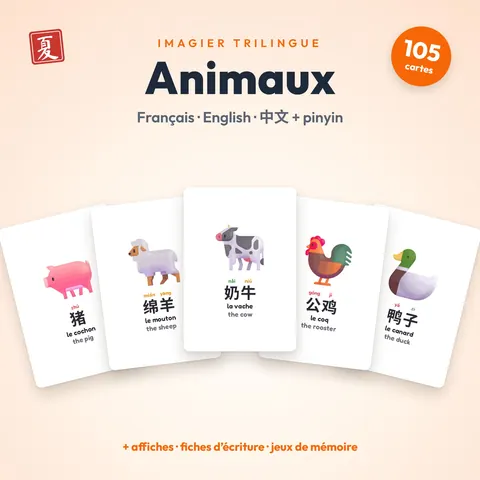
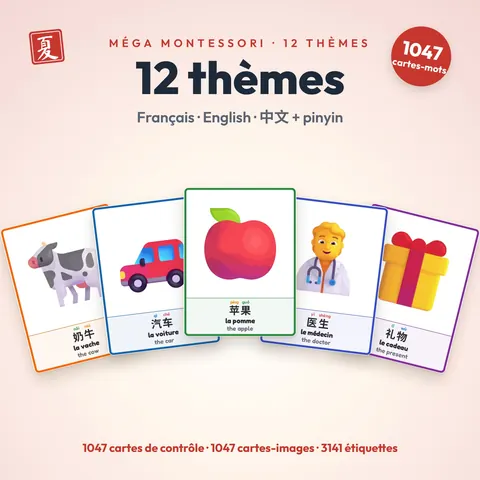
First words are concrete: animals, fruit, things around the house. Show a picture, say the word, the child repeats. A picture card with the word in French, English and Chinese lets the adult read it without hesitating: māo 猫 cat, gǒu 狗 dog, píngguǒ 苹果 apple.
Double-sided flashcards come next: picture on one side, words on the other. The child guesses, turns it over, checks. Put known cards in a box and come back more often to the tricky ones.
Tones, in colour
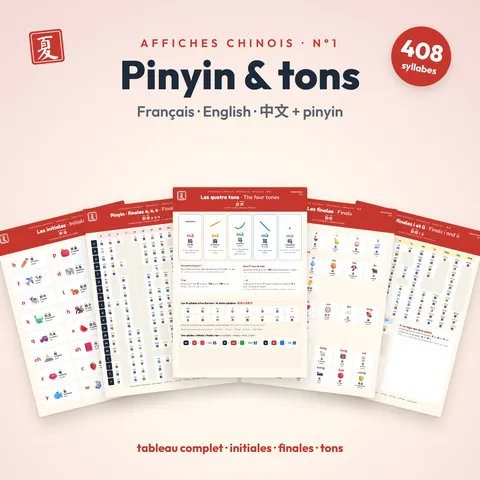
Mandarin has four tones and a neutral tone. The same syllable changes meaning with the tone: mā 妈 mum, mǎ 马 horse. A colour code helps the adult at a glance: red for the 1st tone, orange for the 2nd, green for the 3rd, blue for the 4th, grey for the neutral tone.
The guide on pinyin and tones goes through each tone with hand gestures.
Ten minutes a day
Regularity matters more than length. A short daily routine works better than an hour on Saturday: three cards at breakfast, a song in the car, a memory game in the evening.
Say the everyday things in Chinese too: nǐ hǎo 你好 hello, xièxie 谢谢 thank you, zàijiàn 再见 goodbye, count the stairs from yī 一 to shí 十.
Characters: recognise before writing
Children recognise simple characters early, such as 人 person, 口 mouth, 山 mountain or 水 water. Show the character next to the picture without asking for writing.
Writing comes around age 5 or 6, with tracing sheets on a 田字格 grid: the four-square grid helps place each stroke. Following stroke order (top to bottom, left to right) makes handwriting steadier.
What to do at each age
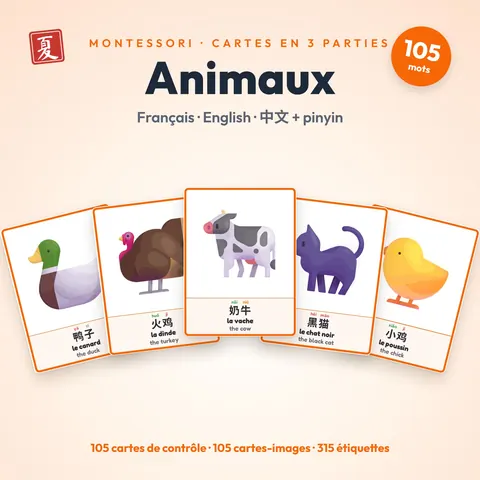
Ages 3 to 5: listen, name, sing, play memory games with pictures. Montessori three-part cards to match picture and word.
Ages 5 to 7: double-sided flashcards, first characters, numbers, short sentences, pinyin as a reading aid.
Ages 7 to 10: writing characters, the pinyin chart, radicals, maths in Chinese, reading simple sentences.
Frequently asked questions
Can I teach my child Chinese if I don’t speak it?
Yes, by relying on native recordings for pronunciation and on materials with pinyin to read the words. The adult learns alongside the child.
What age should we start?
From age 3 with listening and pictures. Characters and pinyin can wait until 5 or 6.
Should pinyin come before characters?
Pinyin mostly helps the adult and children who already read the alphabet. Both are learnt together: pinyin above the character, as on our cards.