Pinyin explained for parents
Your child is learning Chinese and comes home with words in pinyin: xièxie, qǐng, zhōngwén. These are the letters of our alphabet, but they are not read the English way. This guide gives you what you need to read a line of pinyin aloud without misreading it, then to help your child at home.
The idea in one minute
A pinyin syllable has three parts: an initial (the starting consonant, sometimes missing), a final (the vowel and what follows) and a tone, marked above the vowel. In hǎo 好 “good”, h is the initial, ao the final, and the ˇ mark shows the 3rd tone.
Pinyin was designed for Chinese, not for English. Each letter has one fixed value: once you know the ten or fifteen traps, you can read everything. For the tones themselves, see the guide to pinyin and tones in colour; this page focuses on sounds.
Consonants that catch people out
Most consonants sound roughly as in English: m, f, n, l, s, h. The others need some care. The comparisons below are approximations to get started; a native recording is always the reference.
| Pinyin | Roughly like… | Example |
|---|---|---|
| b, d, g | English b, d, g, but softer, close to p, t, k without a puff of air | bā 八 eight |
| p, t, k | English p, t, k with a strong puff of air | pà 怕 to fear |
| j | “j” in “jeep”, tongue flat behind the lower teeth | jiā 家 home |
| q | “ch” in “cheese”, lips spread (never “k” or “kw”) | qī 七 seven |
| x | between “s” and “sh”, lips spread (never “ks” or “z”) | xiè 谢 to thank |
| zh | “j” in “jam”, tongue curled back | zhōng 中 middle |
| ch | “ch” in “church”, tongue curled back, with air | chī 吃 to eat |
| sh | “sh” in “shirt”, tongue curled back | shū 书 book |
| r | between the “r” in “run” and the “s” in “measure” | rè 热 hot |
| z | “ds” in “kids” | zài 在 to be at |
| c | “ts” in “cats”, with a puff of air (never “k” or “s”) | cài 菜 dish, vegetable |
| h | rougher than English h, from the back of the throat, as in Scottish “loch” but lighter | hē 喝 to drink |
j, q, x versus zh, ch, sh
This is the main difficulty. For j, q and x, the tongue stays low and the lips are spread, as in a smile. For zh, ch, sh and r, the tip of the tongue curls up towards the roof of the mouth. The two series never mix: j, q and x are never followed directly by a or o, always by i or ü (jiā, qù, xué).
Vowels and finals that catch people out
| Pinyin | Roughly like… | Example |
|---|---|---|
| u | “oo” in “food” | wǔ 五 five |
| ü | say “ee” with rounded lips (French “u”, German “ü”) | lǜ 绿 green, nǚ 女 woman |
| e | “u” in “duh”, said further back (never “ee” or “eh”) | è 饿 hungry |
| i after z, c, s | not “ee”: just hold the buzzing “z” or “s” | sì 四 four |
| i after zh, ch, sh, r | not “ee”: a dull “r”-like sound, tongue curled | shì 是 to be |
| ian | “yen” (not “yan”) | tiān 天 sky |
| en | “un” in “under” plus n | mén 门 door |
| ong | “oong”, close to “ung” in German “Hunger” | hóng 红 red |
| ui | “way” (short for uei) | duì 对 correct |
| iu | “yo” as in “yo-yo” (short for iou) | liù 六 six |
| un | “wun” ; after j, q, x, y: ü plus n | chūn 春 spring, yún 云 cloud |
| ou | “o” in “go” | gǒu 狗 dog |
| ai, ei, ao | “eye”, “ay” in “say”, “ow” in “cow” | lái 来 to come, hǎo 好 good |
A simple rule: a is always open, as in “father”, never as in “cat” or “late”.
Spelling rules worth knowing
y and w at the start of syllables
When a syllable starts with i, u or ü and has no consonant, it is written with y or w: i becomes yī 一, ia becomes yā 鸭, u becomes wǔ 五, ua becomes wā 蛙, ü becomes yú 鱼. The y and w add no separate sound; they just mark the start of the syllable.
The two dots on ü
After j, q, x and y, ü drops its dots because a plain u cannot appear there: you write qù 去 “to go”, xué 学 “to study”, yú 鱼 “fish”, but still say the rounded ü. After n and l the dots stay, to tell nǚ 女 “woman” from nǔ 努 “to strive”.
The apostrophe
It separates two syllables when the second starts with a, e or o: 西安 Xī’ān (two syllables, the city) is not xiān 先 “first” (one syllable).
Words are joined
Syllables belonging to one word are written together: péngyou 朋友 “friend”, lǎoshī 老师 “teacher”. Spaces separate words, not syllables.
Reading a line of pinyin, step by step
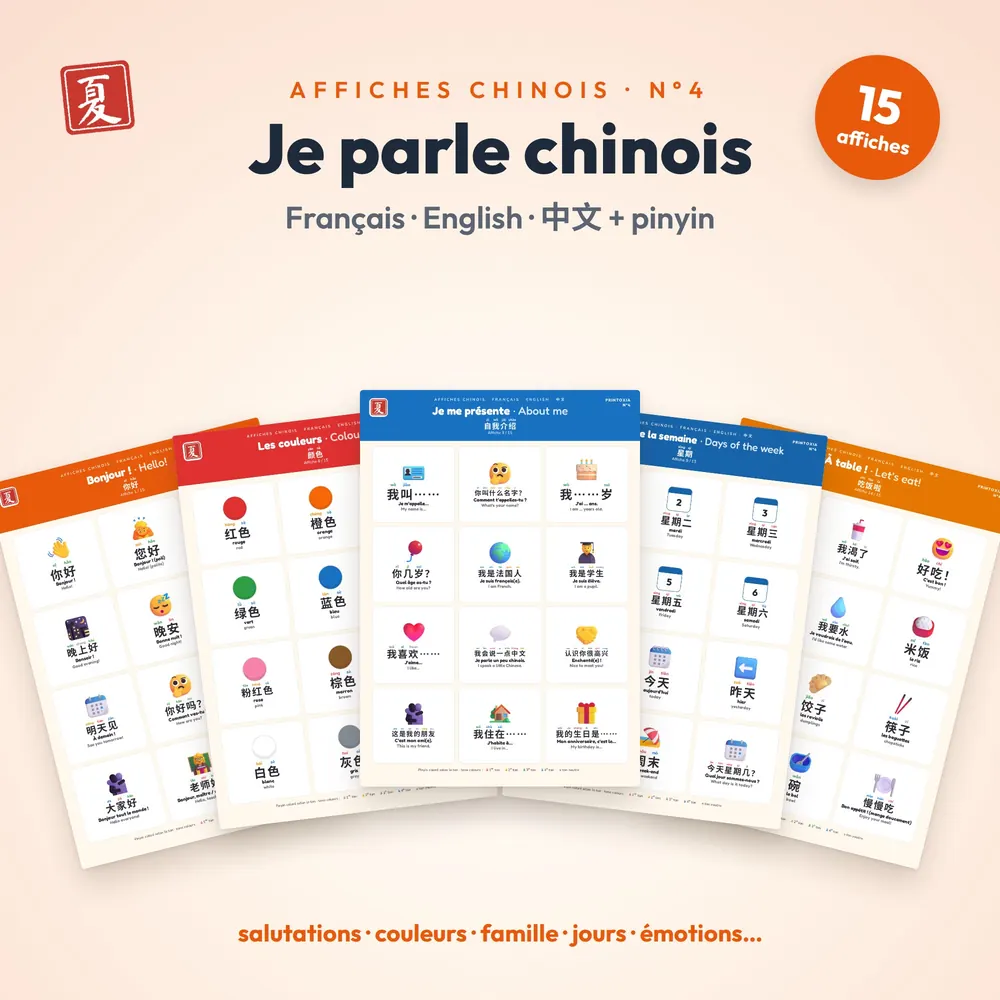
Take a sentence from the “I speak Chinese” posters: 我会说中文。 wǒ huì shuō zhōngwén “I can speak Chinese.”
- Split it into words: wǒ / huì / shuō / zhōngwén.
- Spot the traps: ui is “way”, sh is curled back, zh is a curled “j”, ong is “oong”, en is “un”.
- Read without tones: “waw hway shwaw joong-wun”.
- Add the melody: low 3rd tone, falling 4th, high level 1st, high level 1st, then rising 2nd.
- Listen to a native speaker and repeat the whole sentence two or three times.
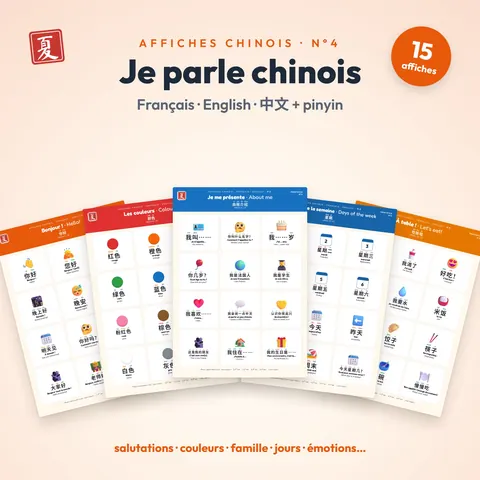
Materials with pinyin coloured by tone help the adult a lot: the colour gives the melody before you even read the small mark.
Helping your child at home
- Let your child read first: after a lesson, they often hear better than you do. Your job is to listen and encourage.
- Check with a recording: free online dictionaries (Wiktionary, MDBG) and apps such as Pleco have audio for most words.
- Keep lists short: five words an evening, read, listened to, then read again the next day.
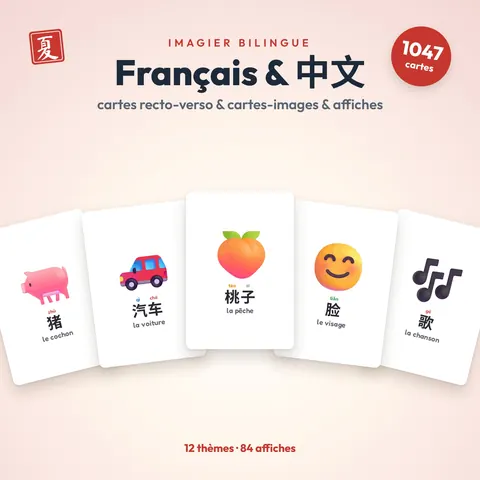
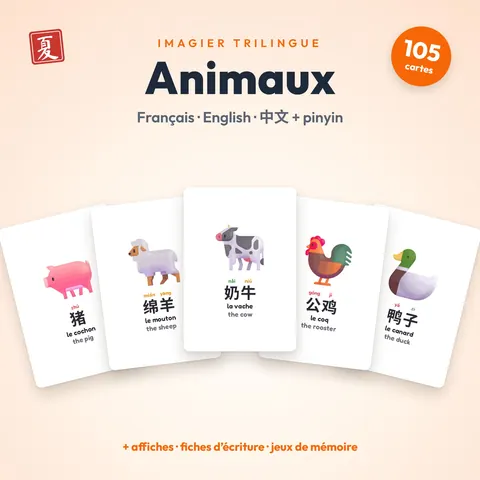
- Use pictures: a word tied to a picture sticks better than pinyin alone. The cards in an English-Chinese picture dictionary do exactly that.
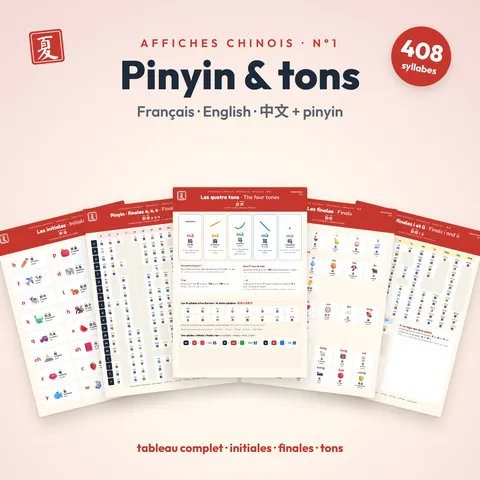
- Put a pinyin chart on the wall: when a sound causes trouble, find the box and its example word together.
Pinyin is a reading aid. As your child recognises more characters, they look at it less: that is a sign of progress.
The most common mistakes
- Reading q as “k” or “kw” (qī is not “kee”) and x as “ks” or “z” (xiè is not “zee-eh”).
- Reading e as “ee” or “eh”: hē 喝 sounds like “huh”, not “hee”.
- Reading zh like the “z” in “zoo”, when the tongue should curl back.
- Saying the i in shì or sì as “ee”: shì is not “she”.
- Reading c as “k” or “s”: cài 菜 starts with “ts”.
- Forgetting that yú, qù and xué contain the rounded ü.
- Skipping tones: without them, mǎi 买 “to buy” and mài 卖 “to sell” become the same word. The guide learning the tones through games has games to practise them.
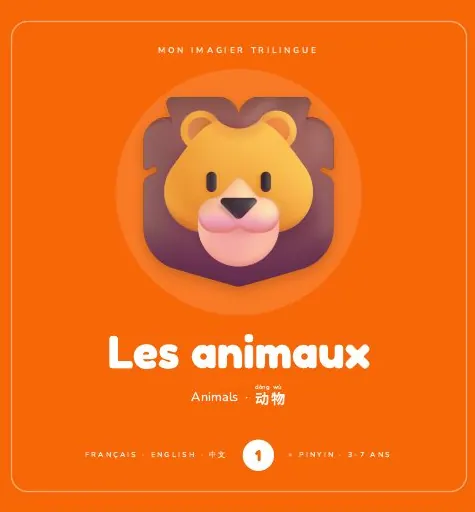
To practise together on simple words, the animal picture book gives each word in French, English and Chinese with pinyin:
Frequently asked questions
Is pinyin read like English?
No. The letters are the same, but several have different values: q sounds like “ch”, x is between “s” and “sh”, c is “ts”, e is close to the “u” in “duh”.
How do you pronounce ü in pinyin?
Say “ee” and round your lips, like French “u” or German “ü”. After j, q, x and y it is written u without dots but sounds the same.
Should children learn pinyin before characters?
They are learnt together. Pinyin above the character helps children read it, and they gradually stop needing it.
How can I check my pronunciation?
Listen to the word in an online dictionary with audio or an app, repeat it, record yourself and compare.
Why is it written yi and wu instead of i and u?
A pinyin syllable does not start with a bare i, u or ü, so y or w is added to mark the start of the syllable. They do not change the sound.