Raising a bilingual child in Chinese and English at home
When one parent speaks Chinese, or both do in an English-speaking country, Chinese quickly becomes the “home” language against the English of school. Here are the approaches that work, the routines to set up and honest answers to the most common worries.
Choose how to organise the languages
There is no single right method, but you do need a clear one. The key point, stressed by the speech therapists NPR spoke to in April 2025, is consistency: the child must hear Chinese often, in real situations, not only in lessons.
One parent, one language (OPOL)
Each parent always speaks their own language to the child: Chinese for one, English for the other. It is easy for the child to understand and easy to keep up if the Chinese-speaking parent spends plenty of time with them. The risk: if that parent works long hours, Chinese only gets a few hours a week against a school day entirely in English.
Minority language at home (MLAH)
Everyone at home speaks Chinese; English comes from school, nursery and friends. This gives Chinese the most hours of exposure. It needs both parents to speak Chinese, at least for everyday phrases. English is not at risk: the surroundings take care of it.
Time and place
A flexible version: Chinese at weekends, at dinner, in the car, at story time. Useful when the Chinese-speaking parent is often away, or when neither parent is native but one speaks it well.
Daily routines that keep Chinese in the air
Phrases that come back every day are learnt without effort. Always say them in Chinese, at the same moment:
- Morning: 起床了 qǐchuáng le “time to get up”, 刷牙 shuāyá “brush your teeth”, 穿衣服 chuān yīfu “get dressed”.
- Meals: 吃饭了 chīfàn le “dinner’s ready”, 洗手 xǐshǒu “wash your hands”, 好吃吗? hǎochī ma “is it good?”.
- Going out: 穿鞋 chuān xié “put your shoes on”, 我们走吧 wǒmen zǒu ba “let’s go”.
- Evening: 洗澡 xǐzǎo “bath time”, 睡觉了 shuìjiào le “bedtime”, 我爱你 wǒ ài nǐ “I love you”.
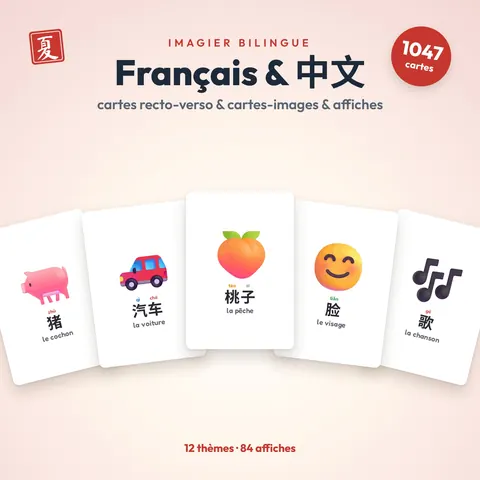
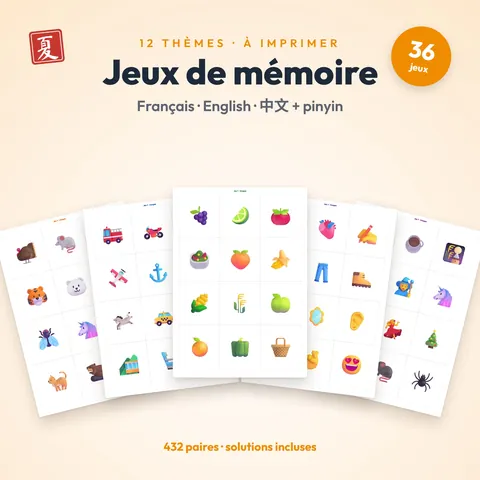
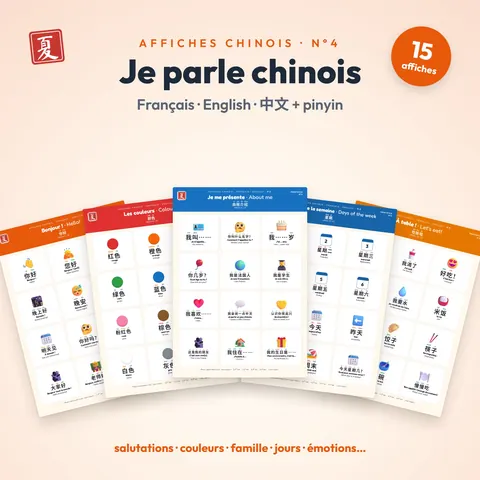
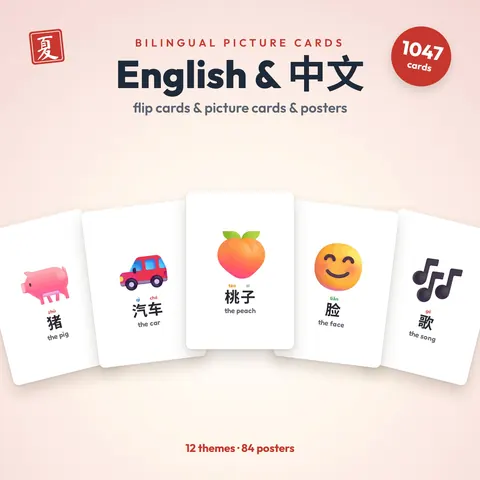
Add a shared reading time in Chinese, even ten minutes, and a picture card game once a week. A wall with a few word posters at child height reminds adults and children alike.
When your child answers in English
Nearly every parent meets this stage, often after starting school: the child understands Chinese but replies in English. It is not a failure; it shows that English is settling in.
What helps
- Keep speaking Chinese without scolding: rephrase in Chinese what the child just said, then carry on the conversation.
- Create real needs for Chinese: grandparents who do not speak English, Chinese-speaking friends, trips to China or Taiwan.
- Ask open questions rather than yes-or-no ones: 你想吃什么? nǐ xiǎng chī shénme “what would you like to eat?”.
- Play “how do you say it in Chinese?”: 用中文怎么说? yòng zhōngwén zěnme shuō.
What gets in the way
Constant correction, forced lessons, and Chinese used only for telling off. Children should link Chinese with good moments: stories, games, cooking, cartoons.
Reading and writing: pinyin, characters, weekend school
Speaking is not enough to read: written Chinese needs separate work. Around age 4 or 5, children can recognise simple characters like pictures: 人 rén person, 大 dà big, 山 shān mountain. Pinyin becomes useful once they read the alphabet in English, often around age 6.
For a child growing up with English, pinyin has a trap: letters are not read as in English (the “q” of qī sounds close to “ch”, the “x” of xiè to a soft “sh”). The guide pinyin explained for parents lists these differences.
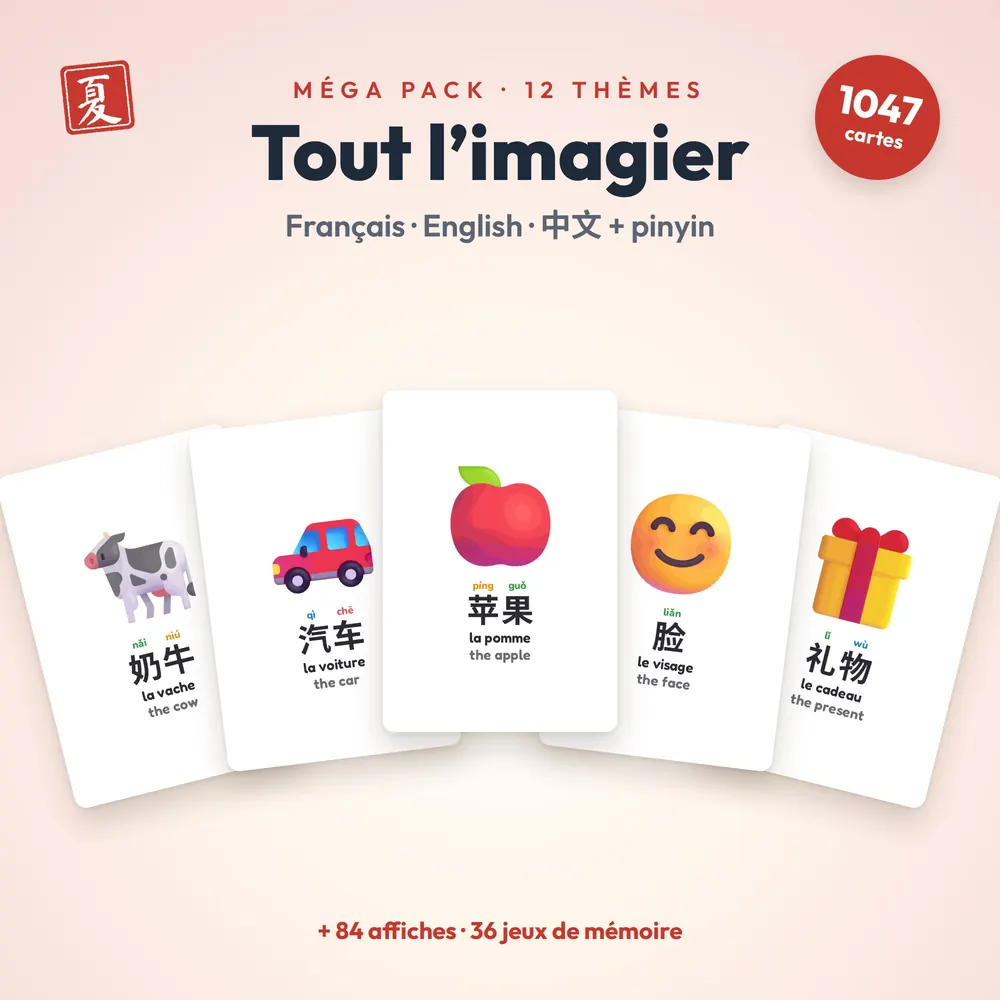
Chinese Saturday or Sunday schools exist in many cities. They give a framework for reading and writing, and classmates who speak Chinese. At home, cards with the character, tone-coloured pinyin and the English word bridge the two languages.
Adding a third language
Many children in this situation also learn a third language, French or Spanish at school, or because a parent speaks it. Three languages are entirely possible. Two tips: give each language its own moments and people, and do not aim for a flawless balance between the three. One language is usually stronger than the others, and that shifts over the years.
Trilingual materials let you work on three languages from the same pictures: one parent reads the word in Chinese, the other in English, a French teacher in French. That is how the “Mon imagier trilingue” collection works, books and printables in French, English and Chinese with pinyin.


Grandparents, video calls and the wider circle
Grandparents are often the best source of Chinese: they have time and stories, and sometimes speak no English. A short, regular video call beats a long, rare one. Prepare a topic: show a drawing, tell them about the day, sing a nursery rhyme.
Useful words: 爷爷 yéye and 奶奶 nǎinai for grandparents on the father’s side, 外公 wàigōng and 外婆 wàipó on the mother’s side. On holiday in China, children often hear more Chinese in two weeks than in two months at home.
Common myths: what can be said
“Two languages delay speech”
Reference sites for parents, such as raisingchildren.net.au, say that bilingualism does not cause language delay. A bilingual child may know fewer words in each language taken alone, but a comparable total. If you are worried about speech, see a speech and language therapist and mention that the child is bilingual.
“Mixing languages means confusion”
Dropping an English word into a Chinese sentence is normal for bilingual children, and for adults too. It shows the child is using every word they know. Simply give the Chinese word back in passing.
“It is too late”
Earlier is easier, but a 7 or 8-year-old who starts Chinese makes good progress with regular exposure. The guide teaching Chinese to a child gives milestones by age.
For a first book to read together, animals remain the easiest theme: Mon imagier trilingue, animals.
Frequently asked questions
Which method should I choose for a Mandarin-English bilingual child?
The one you can keep up over time. One parent one language (OPOL) if only one parent speaks Chinese; Chinese for the whole household if both do. Consistency matters more than the method.
My child understands Chinese but answers in English. What should I do?
Keep speaking Chinese without scolding, rephrase in Chinese, ask open questions, and create situations where Chinese is needed: grandparents, Chinese-speaking friends, trips.
Does bilingualism delay speech?
Reference sources for parents say it does not. If in doubt, a speech and language therapist can assess the child in both languages.
When should children start Chinese characters?
Recognising simple characters can start around age 4 or 5; writing and pinyin around age 6, once the child reads the alphabet.
Can we add a third language?
Yes. Give each language its own moments or people, and accept that one language will be stronger than the others at different times.